What Skill Areas Are Most Challenging in Language Arts

Specific Skill Instruction - ELA
Reading Closely for Textual Details
- V Shut Reading Strategies to Support the Common Core: This educator blog posting outlines five simple strategies to help teach students how to critically read complex texts. (iteachicoachiblog.blogspot.com)
- Reading Instruction Collection: This collection of resource provides reading instructional supports including strategies, tools, handouts, assessments, rubrics, conferring supports and lesson planning tools. (WeTeachNYC.org)
- ELA / Literacy: Text-Dependent Questions - The Common Core State Standards wait students to use prove from texts to nowadays conscientious analyses, well-defended claims, and clear information. A central tool to help students develop these skills is text-dependent questions: questions that can only be answered by referring back to the text. On this link, teachers tin can find tools to help write and evaluate text-dependent questions. (achievethecore.org)
- Ways to Jot While Reading: Classroom Strategies – a few charts that outline possible things to jot about while reading different types of text. (www.weteachnyc.org)
- ANet: Text Dependent Questioning in a Second Course Classroom – In this brusk video, teacher Lucy Makuro shares her arroyo to text dependent questioning with second graders. (youtube.com)
- Grade five: Analyzing Texts Lesson Series: This video serial of four lessons highlights a fifth grade course comprised of predominantly English-as-a-2d-language learners. The focus of these lessons is on how to discuss, analyze, and write virtually an informational text. (teachingchannel.org)
- Analyzing Texts: Overview of a Lesson Series
- Analyzing Texts: Putting Thoughts on Paper
- Analyzing Texts: "Text Talk Fourth dimension"
- Analyzing Texts: Brainstorm Before Writing
Writing
- CCSS for English Linguistic communication Arts and Literacy in History/Social Studies, Science and Technical Subjects - Appendix C: Samples of Educatee Writing
- Writing for Understanding – LOOKING AT AND LEARNING FROM STUDENT WRITING Checklists:Student work is a powerful source of information for teachers almost students' content-and-text based writing. These One thousand – 12 standards-based checklists for each type of writing will help teachers acquire from their own students' piece of work. (Vermontwritingcollaborative.org)
- In Common: Effective Writing for All Students – This resource by The Vermont Writing Collaborative with Student Achievement Partners and CCSSO provides a range of examples of Common-Core aligned student work to demonstrate how a student's writing skills can progress every bit they gain fluency beyond the iii major types of Common Core writing: argument/stance writing, informative/explanatory writing, and narrative writing. Four professional development activities to help build understanding of CCSS grade-level expectations for writing are too included. (reach.org)
- What is The "Painted Essay?" When we write, nosotros are both constructing and communicating pregnant most some torso of knowledge or set up of ideas. To be effective, a piece of writing must be a connected, coherent chunk of thought. When students are learning to write, there are several aspects of the process that may present difficulty. The Painted Essay is an effective way to teach children to write. (vermontwritingcollaborative.org)
- GRAMMAR: Kahn Academy's newest subject - The free videos, practice exercises, and assessments help students (and teachers) learn Standard American English at their own footstep. Exercises include punctuation, parts of speech communication, style and usage, and conventions.(kahnacademy.org)
- Grammar Guide - This guide, developed past the Louisiana Section of Education in partnership with LearnZillion, shows what students' written language should expect like at each grade level. Teachers tin utilise it to identify gaps in written conventions and target areas for education during modest-group or individualized education. In guild to admission this guide from the LearnZillion website, you volition need to register with the site; there is no charge for admission to these materials. Use this link to register. https://learnzillion.com/p/
- Improving Writing Skills: ELLs and the Joy of Writing by Kristina Robertson – This article discusses the important correlation betwixt writing and language development. Information technology also includes how to differentiate writing activities that permit for every students to be successful. (colorincolorado.org)
- "Clarify a Constructed Response Question" a direct instruction video lesson that helps elementary students understand how to determine what a multi-task writing prompt wants them to do. (learn zillion.com)
- GLAD Sentence Patterning Chart – a short video from Mount Vernon Schools that could be helpful to elementary students as well as English Language Learners. (youtube.com)
- Create a Classroom of Writers: Planning for Argument Writing – a blog on 11/22/16 by Joey Hawkins from the Vermont Writing Collaborative posted on the Reach the Core website that explains the purpose of teaching students to write sound arguments and what constructive argument planning and instruction expect like. (achievethecore.org)
- Tcher's Cut Video: When a Lesson Goes Wrong – Preparing to Write a Literary Analysis, Grades nine-12. Sarah Chocolate-brown Wessling unpacks what happened in this video when her lesson went wrong. (teachingchannel.org)
- Write Forth – This drove of interactive video lessons from LearnZillion provides students guidance on how to improve their writing. Each video builds a targeted skill by modeling the process of revising or editing a flawed piece of writing while students go along upward on a practice sheet. At the end, a formative assessment allows students to apply the skill to a new draft. (learnzillion.com)
- Writing a Cooperative Paragraph –In this video lesson, a Grade 2 teacher walks her students (some of whom are ELLs) through a cooperative paragraph summarizing the beginning, middle, and end of BURRO'S TORTILLAS. She also uses the exercise as an opportunity to do their writing skills. (colorincolorado.org)
- How I Finally Figured Out Collaborative Writing – In this blog by Amber Rain Chandler, posted 5-08-16 on the MiddleWeb - All About Centre Grades website, she shares what she has learned this twelvemonth well-nigh having students work collaboratively on writing assignments—and how she graded them. (middleweb.com)
- Learning Can't Be Done in One Draft by Jessica Lander on 1-21-2016 for the Boston Globe - "Computer-coders, chefs, writers, are seldom satisfied with a get-go draft. They write reams of code or bake dozens of éclairs, continually tinkering before they are satisfied. Earnest Hemingway famously penned 47 different endings to his novel "A Farewell to Artillery." Yet students are rarely given the fourth dimension and tools to turn practiced work into great work. Ambitious curriculums race from the Romans to the Romanovs, from genetics to global warming, in a flurry of assignments. Tests oftentimes emphasize breadth over depth. Students aim to complete assignments rather than master adroitness…" (bostonglobe.com)
- Quillprovides FREE learning activities that engage students in the writing procedure through interactive web applications instruction grammer, vocabulary, and writing skills. Teachers can select from over 150 activities congenital from 42 Common Cadre standards for students in grades 3-12. (quill.org)
- Quill just launched a free writing diagnostic tool that covers eight areas of judgement structure, including fragments, run-on sentences, and circuitous sentences. Information technology assesses students and then builds a personalized learning plan for each student that provides upwardly to 40 activities. (quill.org)
- Instruction Secondary Students to Write Effectively: This practice guide presents specific, actionable guidance to help students in grades 6–12 develop constructive writing skills. Information technology is geared towards administrators and teachers in all disciplines who desire to help improve their students' writing. (ies.ed.gov)
- Common Core Writing Prompts and Strategies: a Facing History and Ourselves Publication to assistance students become stronger belittling thinkers and writers. The materials include the post-obit: an overview of current research about argumentative writing that was used to inform this work, specific writing prompts, thinking/writing strategies appropriate for both history and language arts classrooms, explicit alignment with the expectations of the Common Core Standards for Literacy in History/Social Studies. (facinghistory.org)
- Authentic Products Aligned to Common Cadre Writing Standards – This document focuses specifically on the writing component of final products. Ideally, these products are created for an authentic audience, one beyond the classroom and the teacher. (Expeditionary Learning, Plaut and Passchier, January 2015)
Researching to Deepen Understanding
- Inquiry Packs, adult for Kindergarten - Grade v, guide students and teachers through the process of focused research and writing to inform or explain. Each pack contains lessons that follow the Gradual Release of Responsibility by including a total form task (approximately three weeks), a peer supported group task (2 weeks) and for grades 3 – 5, an independent enquiry task (approximately ii weeks). Teachers can choose to utilize one, 2, or three of the components. (vermontwritingcollaborative.org)
- Video Playlist: Educating Digital Citizens(teachingchannel.org)
Vocabulary Acquisition and Use
- Academic Vocabulary in the Common Core: An Introduction(pbslearningmedia.org)
- Academic Vocabulary in the Common Core: Simple School English language Language Arts (pbslearningmedia.org)
- Academic Vocabulary in the Common Cadre: Middle School English Language Arts (pbslearningmedia.org)
- Academic Vocabulary in the Mutual Core: High Schoolhouse English Linguistic communication Arts(pbslearningmedia.org)
- Vocabulary Matters: five Facts, Actions, and Resources - The mode to ensure both word knowledge and world knowledge is to increment the corporeality of well-designed vocabulary teaching in classrooms as well as the amount that students read. This link provides the five virtually critical facts about vocabulary that can transform student learning. Each fact is accompanied by an activeness that educators tin can take right now and a link to an open-access resource on the spider web for supporting that action. (textproject.org)
- Superlative V Vocabulary Strategies for English language Learners - This article offers vocabulary strategies and resource to help all students, especially ELLs, overcome their vocabulary challenges. (teachingchannel.org)
- Academic Word Finder: Grades K-12 – An online tool that helps to support teachers in identifying and teaching Tier ii academic vocabulary within a text. Educators select and enter into the tool a passage from a complex text along with the grade level being taught. The tool then identifies the bookish vocabulary for the selected grade, every bit well as words that fall into grade levels both above and below, and provides student-friendly definitions, parts of speech and sample sentences. (Student Achievement Partners)
- Word Piece of work and Give-and-take Play - A Practice Guide for Vocabulary Didactics in Thousand-12 Classrooms: This guide provides a collection of strategies for both explicit and implicit educational activity to promote bookish vocabulary acquisition. (WeTeachNYC.org)
- Exceptional Expressions for Everyday Events —This free ebook contains a serial of 32 flexible vocabulary development lessons each focusing on an everyday concept. Each activity can be used for a few minutes a day over the course of a week. (textproject.org)
- Vocabulary Learning and Teaching Inside the Literate Classroom — This presentation describes how vocabulary learning and the corporeality that students read and learn tin exist increased in the classroom. tin can be bolstered and how the amount that students read and learn can exist increased in classrooms. (Elfrieda H. Hiebert, TextProject September 2014, Powerpoint)
- Generative Vocabulary Instruction - An article past Elfrieda H. Hiebert (Text Project & Academy of California, Santa Cruz)
- Unique Words Require Unique Teaching–Instruction Words in Stories and Informational Books past Elfrieda H. Hiebert (Text Project & Academy of California, Santa Cruz)
- TextProject Answers Oftentimes Asked Inquiry Questions: Core Vocabulary
Text Complexity
- Essential Insights into Text Complexity and the New Assessments: Three Manufactures from Reading Today by Elfrieda H. Hiebert (Text Project & University of California, Santa Cruz)
- What Features Influence Text Complication for Beginning and Struggling Readers?—Module iii of the Text Project Teacher Development Series provides instructional insight into the skills beginning and struggling readers will need to read increasingly complex texts (Text Project)
- Supporting All Learners with Complex Texts – This resource provides strategies to scaffold instruction of Standards-aligned, complex texts (achievethecore.org)
- Text Complexity and English Learners— Building Vocabulary past Elfrieda H. Hiebert (Text Project & Academy of California, Santa Cruz)
- TextProject Answers Ofttimes Asked Inquiry Questions: Text Complexity
- Lexile framework for reading map [English] [Castilian]
- Lexile measures in the classroom [English] [Spanish]
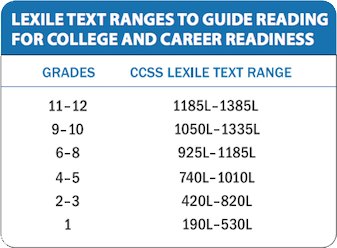
Delight Annotation: The Lexile mensurate (text complication) of a volume is an splendid starting point for a educatee's book option. It'due south of import to empathise that the book's Lexile mensurate should non be the only gene in a educatee'south book selection procedure. Lexile measures do non consider factors such every bit age-appropriateness, involvement, and prior cognition. These are too primal factors when matching children and adolescents with books they might like and are able to read. Lexile codes provide more than information about developmental appropriateness, reading difficulty, and common or intended usage of books. For more information on Lexile codes, please visit Lexile.com. (from The Lexile Framework for Reading Map by MetaMetrics)
- Lexile Text Analyzer(lexile.com)
- Matching Readers with Targeted Text (lexile.com)
- vii Actions that Teachers Can Take Right At present: Text Complexity (textproject.org)
loweryexactionan1944.blogspot.com
Source: https://portal.ct.gov/SDE/CT-Core-Standards/Materials-for-Teachers/ELA/Specific-Skill-Instruction-ELA

Post a Comment for "What Skill Areas Are Most Challenging in Language Arts"